





.jpg?width=930&format=webp&w=75&resize=75,75&ssl=1 "Painful details in accidents like the Şişli massacre")



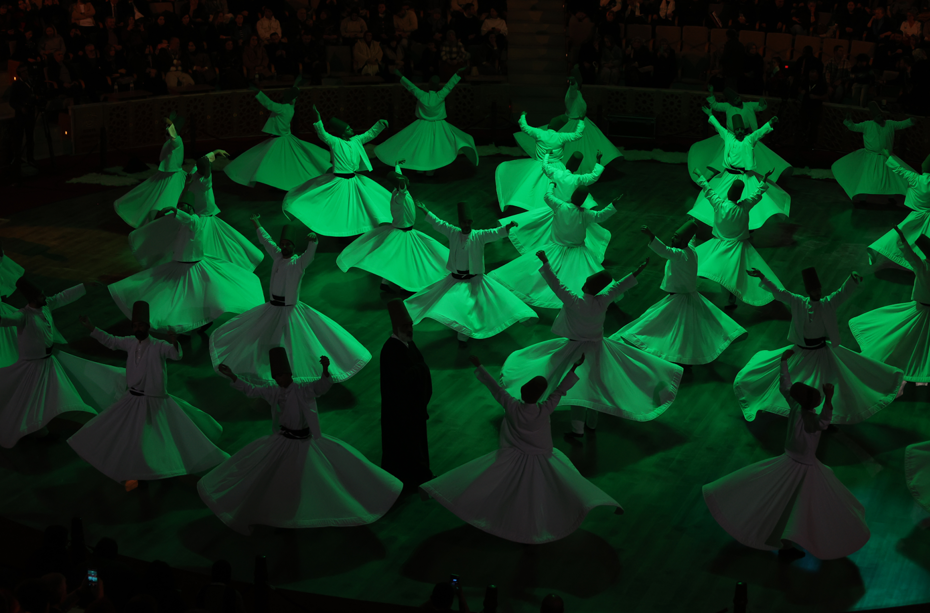
Mevlana Celaleddin-i Rumi was held in Konya on the anniversary of his death. The 752nd anniversary of Mevlana's reunion was commemorated by the 'Şeb-i Arus' ceremony held within the framework of the International Celebration.
Mevlana Celaleddin-i Rumi, born on September 30, 1207, in the city of Belh in Khorasan, located within the border of present-day Afghanistan, died in Konya on December 17, 1273. Mevlana considered the day of death as the day of rebirth and reunion with his beloved, Allah.
Since he called the date of his death 'Şeb-i Arus', meaning 'Wedding Night', Mevlana's date of death is accepted as 'Şeb-i Arus' in Mevleviism.
The feast of 'Vuslat' (Reunion with Beloved Ones) is held on the anniversary of Mevlana's death. 'Hz this year. The celebration of the 752nd anniversary of Mevlana's international reunion ended with the Şeb-i Arus ceremony.
Minister of Culture and Tourism Mehmet Nuri Esroy, Chairman of the Religious Affairs Committee Safi Arpaguş, Konya Governor İbrahim Akın, and Esin Çelebi Bayru, Mevlana's granddaughter of the 22nd generation, attended the ceremony held at the Mevlana Cultural Center.
“MEVLANA IS A ROSE IN THIS ROSE GARDEN”
In his speech, Minister of Culture and Tourism Mehmet Nuri Ersoy criticized those who tried to portray Mevlana as a poet and Mesnevi as a collection of poems. Minister Ersoy said:
“When we look at our ancient history, we see the profound traces of many great people who shaped, changed and transformed the state and society, eventually going beyond this and becoming an example and guide for all humanity. In this lineage, the conquerors of our hearts, from Hacı Bektaş Veli to Yunus Emre, from Sadrettin Konevi to Sultan Veled, from Şems-i Tebrizi to Hodja Nasreddin, always has a separate and special place. Mevlana also has a special place.” This is a rose from the rose garden. Those who try to present Mevlana as a poet, Mesnevi as a book of poetry and Sema as a dance performance should know that, with God's permission, no one has the right to alienate, twist or distort what is ours. Those who are struggling in the sea of fear and anxiety in today's world should say: 'Don't go towards despair, there are many doors of hope, many suns are shining'. “I invite you to Mevlana's fireplace.”
“ALL OUR EFFORT IS TO ACHIEVE PEACE AND FIND PEACE”
After the ceremonial speeches, the Mesnevi Speech was presented by the Chairman of the Religious Affairs Committee, Safi Arpaguş. Expressing that humanity is a journey of search, Arpaguş said, “Even though this search may be like a breath of health for some of us, a social status for some of us, or a moral trait for some of us, all of our efforts are to achieve peace and find peace. We are pursuing peace and we find our humanity insofar as they are I seek peace. We achieve our goals by being ready for God's presence.” he said.
SEMA SHOW AT ŞEB-İ ARUS CEREMONY
After Mesnevi Talk, a Sufi concert by artist Ahmet Özhan was organized by the Istanbul Historical Turkish Music Ensemble in association with the Ministry of Culture and Tourism. Afterwards, the Konya Turkish Sufi Music Community performed a sema performance.
The whirling dervishes, watched with amusement by the guests, are performed by whirling dervishes, who are referred to as Mevlevi dervishes.
Sema is the servant's turning towards the truth, exalting himself with reason and love, abandoning the ego, disappearing into the truth and returning to slavery as a mature, perfect human being.
EVERY CLOTHING HAS A MEANING
The coin 'turban' on the head of the whirling dervishes performing the whirling ritual in special clothes symbolizes the tombstone erected at the head of the Mevlevi system after death, the cardigan symbolizes the grave, and the shroud 'tennure', which is a sleeveless white garment, narrow at the top and wide at the bottom. Off-duty, a 'destegül' unbuttoned and unbuttoned vest is worn, around the waist is an 'elifi nemed' belt, four fingers wide and resembling the letter elif in the Arabic alphabet.
In a whirling fervent performance accompanied by Sufi music, the whirling dervishes first cross their arms, seemingly representing the number 'One', thus affirming the unity of Allah.
He then opens his arms to the sides and performs dhikr, his right hand open as if in prayer, and his left hand open down. This means, 'We take from the truth and distribute it to the public, we do not appropriate anything for ourselves, we are nothing more than a semblance of intermediary.'
That is how He turns around His heart from right to left and embraces everyone, every living thing, with all His heart and love. Each part of the sky consists of seven parts, carrying a different meaning.





.jpg?width=930&format=webp&w=120&resize=120,86&ssl=1 "Painful details in accidents like the Şişli massacre")

